

Gastroschisis
A gastroschisis is a birth defect in which an opening in your baby's abdominal wall allows the stomach or intestines to protrude outside of the body and float in the amniotic fluid. The amount of abdominal contents outside the baby varies from very small - just a few loops of bowel - to quite large, involving most of the intestines and stomach. It is not known why this happens, but the opening occurs when the abdominal wall muscles develop incorrectly. The majority of babies with this problem are born to mothers in their late teens or early 20s.
Longterm outcome with gastroschisis
There is a range of severity for fetuses with gastroschisis that depends entirely on the condition of the intestine. Fortunately, most fetuses with gastroschisis do not have severe damage to the intestine before birth. The relatively normal intestine can be returned to the abdomen and the defect closed in one or two surgical operations shortly after birth. These babies will still be in the intensive care nursery for several weeks before the intestines work well enough to allow feeding and subsequent discharge home. However, these babies eventually feed normally and grow up normally.
Prenatal diagnosis and fetal treatment
Around the 16th week of your pregnancy, a blood test measuring a protein called alphafetoprotein (AFP) showed abnormally high results, triggering your obstetrician to order an ultrasound study. Ultrasound uses sound waves to create a picture of your developing baby. The ultrasound showed intestine floating in the amniotic fluid outside the baby. Mothers don't experience any unusual symptoms from their fetus.
Monitoring your pregnancy
Although it is important to carefully monitor your pregnancy with ultrasound studies, other tests usually aren't recommended because this is condition isn't associated with other birth defects. Rarely, gastroschisis can produce a bowel obstruction or blockage. Your doctor will watch for fetal growth restriction, which means the baby isn't growing enough, and for damage to the intestines caused by exposure to the amniotic fluid or impaired blood flow to the exposed intestine. How often you have an ultrasound study is determined by your individual condition. Your perinatologist, a specialist in fetal and maternal medicine, will discuss your delivery plans. It isn't necessary to deliver your baby by cesarean section.
For more information about prenatal diagnosis and fetal treatment visit Fetal Treatment Center: Gastroschisis
What will happen after my baby is born?
Your baby should be born at a hospital with an intensive care nursery (ICN) and a pediatric surgeon available because your child will need surgery soon after birth. If the gastroschisis is too large to be closed during the surgery, a covering called a silo is placed over the exposed abdominal organs. Then, the organs are manually squeezed through the silo into the opening and returned to the body in a gradual process that can take up to a week.
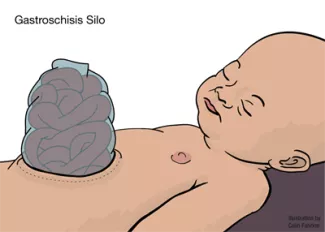
Babies with gastroschisis can stay in the hospital from two weeks to three to four months. Because your baby's intestine has been floating in amniotic fluid for months, it is swollen and doesn't function well. Babies are discharged from the hospital when they are taking all their feedings by mouth, gaining weight and intestinal function has returned.
After hospital discharge, your baby is at risk for bowel obstruction due to scar tissue or a kink in a loop of
bowel caused by the operation. Bowel obstruction symptoms include:
- Bilious or green vomiting
- Bloated stomach
- No interest in feeding.
If any of these symptoms occur, contact your pediatrician immediately.